Guides
Commercial DSCR Loans: A Beginner’s Guide to Financing Larger Rental Properties
Learn how commercial DSCR loans work for apartment buildings and mixed-use properties, how lenders calculate coverage, and what to compare before applying.
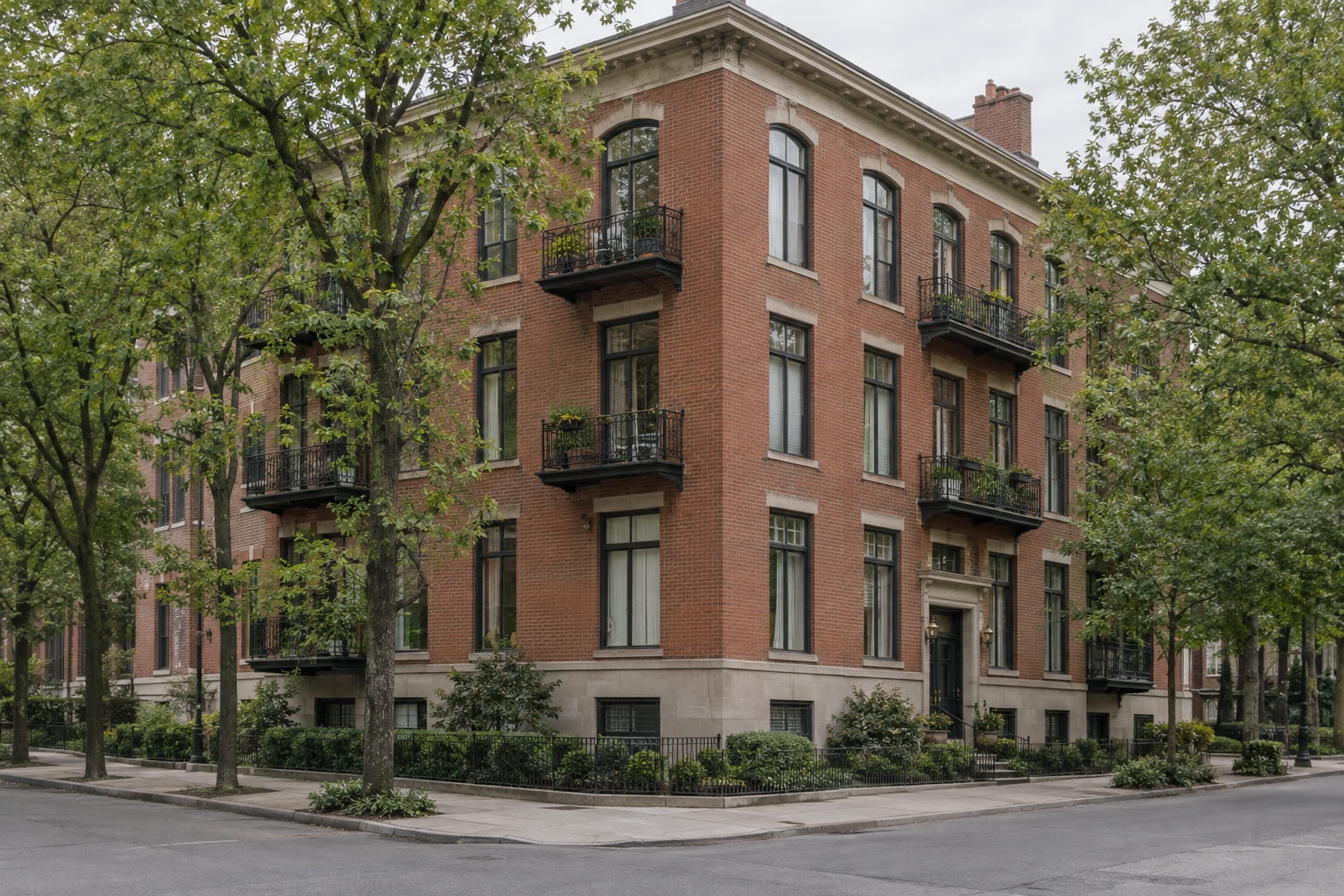
Properties with five or more apartments generally fall under multifamily lending.
A commercial DSCR loan can finance an income-producing property, such as an apartment building with five or more units or a building with apartments and storefronts. For many commercial loans, the lender calculates DSCR by dividing the property’s annual income after operating expenses by its annual loan payments. The result shows whether the property earns enough to cover those payments.
The calculation is not identical across lenders and loan programs, however. Before you rely on an online DSCR estimate, ask which rent, vacancies, expenses, and loan payment the lender will use for your property. Those choices can change your DSCR and how much you can borrow.
What is a commercial DSCR loan?
A commercial DSCR loan is a loan on an investment property that is evaluated in part on the cash the property produces relative to its debt payments. Depending on the lender, it may be a private small-balance loan, a bank commercial mortgage, or a multifamily loan offered through an agency lender. These are different products with different rules.
The property’s income matters, but the lender may also review your credit, experience, available cash, and how you plan to own the property. Ask whether you must personally guarantee the loan, which could make you responsible for repayment if the borrowing business cannot pay.
Which properties can use a commercial DSCR loan?
Apartment buildings with five or more units are common candidates for a commercial DSCR loan. Depending on the lender, a mixed-use building with apartments and storefronts, or a retail, office, or industrial property, may also qualify. Some lenders finance apartment buildings but do not offer DSCR loans for mixed-use, retail, office, or industrial properties.
However, even when two lenders finance the same type of building, they may calculate DSCR differently. For a five-unit property, Fannie Mae’s multifamily program compares the property’s income after operating costs with its annual debt payments. Mortava’s five-to-nine-unit program, on the other hand, divides gross monthly rent by a monthly payment that includes taxes and insurance. The number of units alone cannot tell you which calculation a lender will use.
The word commercial can add to the confusion. A loan for a single-family rental may be called commercial because the property is used for business, even though the lender evaluates its rent differently from a larger apartment building. Tell the lender what type of property you have and ask which program and DSCR formula apply.
How do lenders calculate commercial DSCR?
Many commercial lenders calculate DSCR by dividing the property’s annual net operating income (NOI) by its annual debt service. NOI is the income expected after allowing for vacancies and paying operating costs, but before loan payments. Debt service is the required loan payments for the year.
Commercial DSCR = annual NOI ÷ annual debt service
The lender’s rules determine which property income and loan payment go into that formula. For example, Fannie Mae’s multifamily program uses underwritten net cash flow, which accounts for an allowance to replace major building items. Even if the loan starts with interest-only payments, Fannie Mae calculates DSCR using a payment that includes principal. Ask your lender which income figure and loan payment it will use before relying on your own estimate.
What goes into NOI?
Net operating income (NOI) is the income a property is expected to earn after vacancies and normal operating costs, but before loan payments. Income may include apartment rent and recurring payments for parking, laundry, or leased commercial space. Operating costs include property taxes, insurance, routine repairs, owner-paid utilities, and management. A lender may use its own estimates for vacancy or expenses, even if you manage the building yourself.
Mortgage payments do not come out of NOI. They are compared with NOI in the DSCR calculation. A one-time renovation budget is also separate from routine operating costs. Some lenders make further adjustments after calculating NOI: Fannie Mae’s small-loan analysis, for example, includes an allowance for replacing major building items when it calculates the cash flow available to cover loan payments.
How does commercial DSCR differ from a one-to-four-unit rental calculation?
Many lenders financing one-to-four-unit rentals divide qualifying monthly rent by monthly PITIA: principal, interest, property taxes, insurance, and any association dues. That formula includes taxes and insurance in the payment, but it usually does not subtract vacancy, repairs, or management costs from the rent.
The commercial NOI method handles those costs differently. It subtracts vacancy and operating expenses, including taxes and insurance, from property income before comparing what remains with the loan payments. Both methods may produce a DSCR of 1.20, but they have counted different expenses. The ratios therefore do not tell you the same thing about how much cash the property may have left.
| Question | Rent ÷ PITIA program | NOI ÷ debt service program |
|---|---|---|
| What income is counted? | Qualifying rent under that lender’s rules | Property income after vacancy and operating expenses |
| Where are taxes and insurance? | In the payment denominator | Normally deducted in calculating NOI |
| Are repairs and management reflected? | Often not directly in the ratio | Generally included in operating expenses |
| What should you confirm? | Which rents qualify and how the payment is calculated | Which income, expenses, reserves, and loan payment are used |
A building’s unit count does not determine which formula a lender will use. A five-unit property, for example, could be evaluated using either calculation in the table, depending on the loan program. Ask the lender to show the rent, expenses, and loan payment behind its DSCR so you know what the result actually measures.
What does a commercial DSCR number mean?
A 1.00 DSCR means the income used in that calculation equals the loan payments used in it. A 1.25 DSCR means $1.25 of qualifying income for each $1 of debt service. A ratio below 1.00 means the measured income falls short of the measured payments.
There is no standard DSCR minimum for every commercial DSCR loan. Fannie Mae’s conventional multifamily term sheet lists a 1.25 DSCR minimum; other lenders and small multifamily products can set different thresholds and use different calculations. You must compare both the minimum and the method.
A six-unit example
Suppose a six-unit building rents for $1,500 per unit each month. Its scheduled rent is $108,000 a year. After an allowance for vacancy and its ordinary operating costs, including taxes and insurance, suppose the lender accepts $66,392 of annual NOI. A proposed loan has $56,636 in annual principal and interest payments.
$66,392 ÷ $56,636 = 1.17 DSCR.
That means the building has about $9,756 left from the NOI used in this example after the scheduled debt payments. It is a narrow cushion: an insurance increase, an extended vacancy, or a major repair could absorb it. The 1.17 is an illustration, not an approval or a prediction of take-home cash. A lender can arrive at a different figure by changing its income, expense, reserve, or payment assumptions.
How much can you borrow with a commercial DSCR loan?
Lenders may set several limits on how much you can borrow. Loan-to-value (LTV) compares the requested loan with the property value the lender accepts. DSCR checks whether the property’s income supports the proposed loan payments. Some programs also require a minimum debt yield, which compares income after operating expenses with the loan amount. Your loan must meet each requirement, so the one that allows the least borrowing may set your maximum. You’ll also need to meet the program’s loan-size rules and have enough cash for the down payment and closing costs.
In the six-unit example above, if a lender required a 1.25 ratio using that same $66,392 NOI, the annual debt service would need to be about $53,114 or less. At the illustrative 7.5% rate and 30-year amortization used for the $56,636 payment, that would support a loan of roughly $633,000 instead of $675,000. The difference is about $42,000 in additional equity before closing costs. The rate, term, appraisal, and lender’s own NOI calculation can change the answer.
If a lender mentions another cash-flow test, our guide to debt yield versus DSCR explains what each number measures. A lower rate, a smaller loan, or a longer amortization can lower payments and improve DSCR, but the full repayment terms still matter.
What else will a lender review?
The rent roll and operating history
A rent roll lists the units, tenants, rents, and lease status. A trailing 12-month statement, often called a T-12, shows the property’s actual income and expenses over the last year. Lenders use these records to check whether the rents are being collected and whether the claimed NOI is realistic. They may request leases, recent financial statements, tax and insurance information, and explanations for unusual expenses or vacant units. Fannie Mae’s multifamily income guidance, for example, calls for reviewing operating statements and rent roll updates.
For a purchase, ask the seller for a current rent roll, leases, and operating history before treating the asking price’s “projected income” as real. If the building has just been renovated or has several empty units, ask whether the lender will use current income, supported future income, or a different loan designed for a property still being leased up.
The appraisal and the property itself
A commercial appraisal looks at the property’s market and earning ability, along with relevant comparable sales and other evidence. It may test the rents, expenses, and capitalization rate used to estimate value. A lower appraised value can reduce the loan even if the property clears the DSCR test. The lender may also require condition or environmental reports. Read our DSCR loan appraisal guide to see how a lower value or rent estimate could affect your loan and what to check in the report.
The borrower and ownership structure
Expect questions about your cash to close, reserves, credit, and track record with rental property. Requirements vary: one program might want prior multifamily ownership, while another might accept experience with smaller rentals. A loan in an LLC can still require a personal guaranty. Ask which people and entities must sign before you form or change an ownership structure. Our guide to DSCR loans and LLCs explains the basic terms.
What changes for a mixed-use building?
A building with apartments above a storefront has two kinds of space and potentially two kinds of leases. The lender needs to know whether the commercial tenant’s rent can be counted, how stable that tenant is, and how much of the building’s income comes from commercial space. A vacant storefront may be treated very differently from one with a signed lease.
Do not assume an apartment-building DSCR product accepts mixed-use property. Mortava explicitly excludes mixed-use from its 5–9 unit product, and YouLand excludes commercial real estate such as retail and office from its multifamily rental program. Other commercial programs can consider those property types. Ask for the specific limits on commercial space or income and whether a lender needs to review the commercial lease.
How should you compare commercial DSCR loan offers?
Start by giving each lender the same rent roll, operating figures, property details, and requested loan amount. Then compare written terms, not just a headline interest rate.
- Underwriting: What DSCR formula and minimum apply? What rents, vacancy allowance, management cost, and reserves will the lender use?
- Cash needed: What is the maximum LTV? How much down payment, closing costs, escrows, and post-closing cash does the lender require?
- Repayment: Is the rate fixed or adjustable? What is the loan term versus the amortization period? If the term ends first, when is the remaining balance due?
- Flexibility: Is there a prepayment charge? Is a personal guarantee required? Does the loan have ongoing financial reporting or coverage requirements?
- Property fit: Does the program allow your unit count, occupancy level, location, and any commercial space?
A five- or ten-year loan term with payments calculated over 30 years can leave a balance due when the term ends. Prepayment terms matter if you plan to sell or refinance sooner. Fannie Mae’s multifamily term sheet, for instance, distinguishes the loan term from amortization and lists potential prepayment charges.
Frequently Asked Questions
It usually belongs in the multifamily financing conversation, but the lender decides which product applies. Five units do not guarantee an NOI-based DSCR formula. Ask how the lender treats that exact property.
It depends on the program and how its ratio is calculated. As one concrete example, Fannie Mae lists 1.25 for its conventional multifamily product; private small multifamily lenders can publish other minimums. Get the requirement for your property and loan structure in writing.
Some property-focused programs do not use your personal debt-to-income ratio or tax returns to size the loan. They can still review credit, funds, experience, and guarantees. Ask for the full document list the lender requires before applying.
Yes, if the property and new loan meet the lender’s rules. A commercial DSCR refinance replaces the existing loan on an eligible income-producing property. With a cash-out refinance, you take a larger new loan and receive what remains after the old loan and closing costs are paid.
Possibly, but empty units may leave the building with too little income to support the loan, and a lender may not count projected rent the same way it counts signed leases. Tell the lender how many units are occupied, what the current tenants pay, and whether the building needs repairs. Ask if it can finance the property now or if you would need a renovation or short-term loan while you fill the vacant units.
DSCRLoans101 is an independent editorial site. We do not originate loans and we are not affiliated with any lender. Every figure on this page comes from published lender materials or primary sources, and we publish the date we verified it.
More in Property Types See every guide in this section