Guides
DSCR Construction Loans: How to Finance a Rental You Build
Building a rental? Learn how construction financing and a DSCR loan work together, what a single-close option changes, and how to plan the refinance.
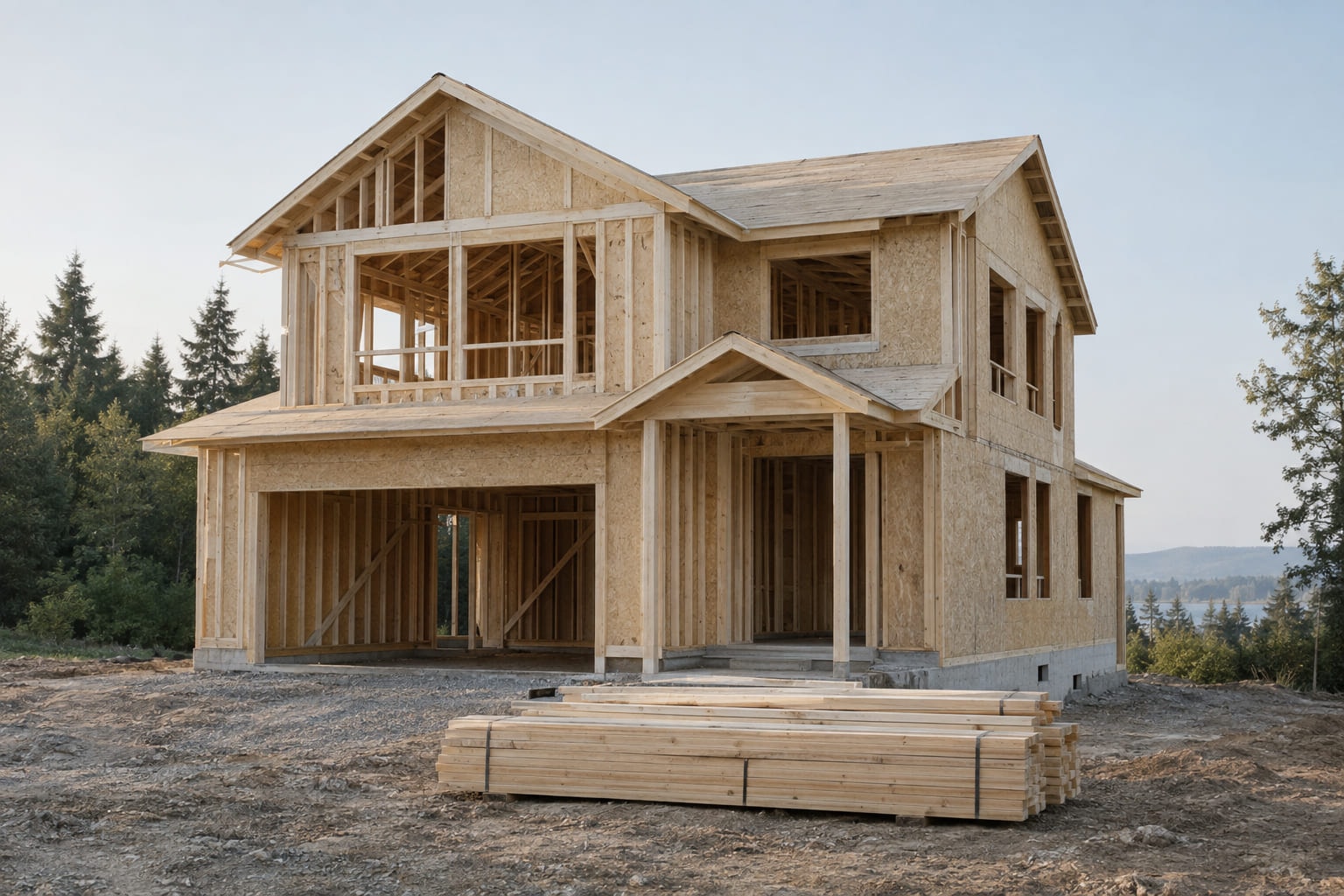
A construction loan pays for land or building work, often in stages as work is completed.
If you plan to build a rental property, a standard DSCR rental loan usually comes after construction. A construction loan provides the money to build. When the property is finished and meets a rental lender's requirements, a DSCR loan can pay off that short-term debt and finance the property for a longer hold.
Some lenders offer a single-close construction-to-permanent loan that combines the phases. That is a different structure from taking out a standard DSCR loan on a completed rental. Whichever route you consider, estimate the permanent loan before committing to the build. You need to know whether it can pay off the construction loan and what cash you might need at the transition.
Can you use a DSCR loan to build a rental property?
Usually, the standard long-term DSCR loan is the financing you use once the rental is complete. It is designed to evaluate a rent-ready property's income against its proposed mortgage payment. It normally does not release funds to a builder as work progresses. A construction loan can provide those funds in stages as the work is completed.
When a lender advertises a “DSCR construction loan,” find out whether the building phase and the long-term rental mortgage are one loan or two. With two loans, you close on construction financing first, then apply for a separate DSCR loan after the property is finished. That new loan must qualify and be large enough to pay off the construction loan. With a true single-close construction-to-permanent loan, you close once at the start and the loan changes to permanent financing when the conditions in your agreement are met.
The program details matter. For example, Lima One calls its Build2Rent program a two-close option. Kiavi advertises single- and dual-close new-construction options, but its page does not clearly say whether the single-close option becomes a permanent DSCR mortgage. Ask when the permanent loan is approved, whether you must close again, and what must happen before construction financing ends.
What does the construction loan pay for?
Depending on the program, a construction loan can help purchase the lot and pay approved building costs. The lender reviews the plans, budget, schedule, builder or general contractor, and your available cash. It then releases construction funds in draws as work reaches agreed stages, rather than handing over the entire building budget at the start. Ask whether draws reimburse completed work or can pay contractors directly, what proof is needed, how long approval takes, and who covers a cost overrun. Lima One, for example, says it reviews building plans, an itemized budget, and the general contractor.
Construction loans are generally short-term. During the build, many lenders charge interest only on money they have released, so your interest payment grows as more funds are drawn. Ask whether your loan works that way, whether you’ll pay the interest from your own cash or from an interest reserve included in the loan, and what it would cost to extend the loan if construction runs late.
What does the DSCR loan do afterward?
Once construction is complete, a DSCR lender reviews the finished property’s condition, supported rent, and appraised value to decide whether it can approve a long-term DSCR loan. If approved, that new loan pays off the construction loan. After refinancing costs, you may receive cash back if the lender permits a larger loan. If the approved DSCR loan is not enough to cover the construction-loan payoff and costs, you would need to bring cash to closing.
The finished property’s rent is one factor in how much you can borrow. The DSCR lender then compares the rent it can use with the full monthly cost of the proposed loan. For many one-to-four-unit rental programs, that cost includes principal, interest, property taxes, insurance, and any association dues, together called PITIA. If the lender accepts $2,500 a month in rent and the new loan’s PITIA is $2,000, the DSCR is 1.25 ($2,500 ÷ $2,000).
A new rental may be ready for tenants before it has a signed lease. Some lenders will use an appraiser’s estimate of market rent at that stage; others require different proof of rental income. Before counting on the DSCR loan to pay off the construction debt, ask when the lender will consider the property complete and what rent evidence it will accept. Our guide to what a DSCR loan is explains the rental-loan basics.
If you are building five or more units or a mixed-use property, the permanent loan may follow multifamily or commercial underwriting instead. A lender may use income after operating expenses rather than the rent ÷ PITIA formula above. Start with our commercial DSCR loans guide and ask for the DSCR formula that applies to your project.
What are your financing options?
| Option | How it works | Main questions to ask |
|---|---|---|
| Two loans | Close a construction loan, finish the rental, then apply for a separate DSCR refinance. | Will the completed property qualify, and will the new loan pay off the construction balance? What are both sets of costs? |
| Single-close construction-to-permanent | One arrangement funds construction and then moves into a permanent rental-loan phase under the program's conditions. | Is the permanent rate fixed now? What must be true at conversion? Can the loan amount, rate, or other terms change? |
With two loans, you can compare permanent lenders closer to completion, but the future rate, appraisal, rent estimate, and final approval are not set when construction begins. Even when the construction lender also offers DSCR loans, ask whether the refinance is a separate application and closing. One lender says its program waives its usual seasoning requirement on the move from its construction loan to its rental loan. However, that is a feature of that specific program, not a rule for all lenders.
A single-close option can reduce the need for a separate refinance. One lender describes a one-time-close build-to-rent program with an in-house permanent phase. But “single close” alone does not tell you whether the permanent interest rate is locked, how conversion is approved, or what happens if completion or occupancy is delayed. Get those terms in writing and compare the total fees and payments with a two-loan plan.
How do you know whether the DSCR refinance will pay off the construction loan?
The finished property’s estimated value and expected rent give you a starting point for planning the refinance. A realistic rate for the new loan, along with property taxes, insurance, and any association dues, helps you estimate its payment and DSCR. From there, the lender can determine the maximum refinance amount under its loan-to-value (LTV), DSCR, ownership seasoning, and cash-out rules.
LTV compares the new loan amount with the value the lender is allowed to use. The completed appraisal is important, but a lender might limit the value used for a recent project to your documented cost or apply a special rule to cash taken out soon after completion. Seasoning means a lender's required time since an event such as buying the lot, completing construction, or starting the lease. This varies by program and by refinance purpose.
A build-to-rent example
Suppose land and construction cost $400,000. You use $60,000 of your cash and borrow $340,000 through a construction loan. Once complete, the house is expected to appraise for $500,000 and rent for $3,400 a month. Estimated taxes and insurance total $600 a month.
At a hypothetical 7.25% rate over 30 years, a $375,000 DSCR loan has about $2,558 in monthly principal and interest. Adding $600 in taxes and insurance gives PITIA of about $3,158. The estimated DSCR is $3,400 ÷ $3,158 = 1.08.
At first glance, $375,000 looks sufficient: it could pay off the $340,000 construction balance and leave $35,000 before refinance costs. But that assumes the lender permits a loan equal to 75% of the $500,000 appraisal and that the project meets its other rules.
| Illustrative value allowed for 75% LTV | Maximum loan on value alone | Compared with $340,000 payoff |
|---|---|---|
| $500,000 completed appraisal | $375,000 | $35,000 above payoff, before costs |
| $400,000 documented cost | $300,000 | $40,000 short, before costs |
These rows show what a value rule could do, not what every lender will do. The smaller loan would also have a lower payment and a higher DSCR, but that does not solve the $40,000 payoff gap. Ask the lender which value it will use for a newly completed rental and whether proceeds above the payoff count as cash-out.
What if the permanent rate or rent changes?
Using the same $375,000 loan, a hypothetical rate increase from 7.25% to 8.25% raises principal and interest to about $2,817 a month. With the same $600 for taxes and insurance, the ratio drops from 1.08 to about 1.00 ($3,400 ÷ $3,417 ≈ 0.995 before rounding). A lower appraiser-supported rent or higher insurance bill would reduce it further.
A low DSCR may still leave you with financing options. Lenders set different minimums, and some offer lower-DSCR or no-ratio programs. Griffin Funding, for example, has no universal DSCR minimum; whether you can take cash out without a seasoning period depends on the program. Test the refinance using several realistic loan payments, then confirm which DSCR, seasoning, and cash-out rules apply to your project. Our guide to what counts as a good DSCR shows how different ratios may affect your refinance options.
If you are targeting a 1.25 ratio in this example, the loan size at 7.25% would be only about $311,000 on the stated rent and taxes. That is about $29,000 below the $340,000 construction payoff, before refinance costs. A loan can produce a comfortable DSCR and still leave you short at the refinance.
How much cash should you plan to have?
Start with the cash the construction lender requires. Then add the costs that can arise before the rental starts paying you: closing fees, interest payments, insurance, taxes, permits, utilities, contingency funds, and months spent finding a tenant. Keep enough available for the gap between paying a contractor and receiving a draw if the lender reimburses completed work.
The example's $35,000 above the construction payoff is not profit. Suppose the $340,000 construction loan charges a hypothetical 11% interest-only rate, with an average of 60% drawn during a nine-month build and the full amount outstanding for three more months while you finish and lease the home. Estimated interest is about $26,180. If you pay that interest from cash, your $60,000 initial contribution plus interest totals $86,180. After a $375,000 takeout pays off $340,000 and an illustrative $11,250 in refinance costs, you receive about $23,750 back. Roughly $62,430 of your cash remains in the property.
That simplified calculation excludes construction-loan points and fees, other holding costs, reserves, and possible overruns. It also assumes the full $375,000 refinance is allowed. Ask both lenders for itemized estimates and run the numbers using a smaller takeout as well.
What can go wrong between the first loan and the second?
- Construction takes longer: Interest and other holding costs continue. At 11% on a fully drawn $340,000 balance, interest alone would be about $3,117 for an extra month.
- The build costs more: An approved loan may not automatically grow with your budget. Ask how change orders and overruns are funded and when extra cash must be provided.
- The finished value or rent is lower: A smaller accepted appraisal can lower the maximum loan; a lower qualifying rent can reduce DSCR and the amount a lender will offer.
- The refinance cannot close yet: Completion documents, property condition, a lease or market-rent evidence, title history, and seasoning requirements may affect timing. Ask about the construction loan's extension options before you need one.
What should you ask lenders before you build?
First, ask the construction lender for a written budget of cash needed at closing, draw timing, interest, fees, and extension costs. Confirm its treatment of the land you already own, the builder's qualifications, and who pays if costs exceed the approved budget. Lima One, for example, says its new-construction underwriting includes a line-item budget and general-contractor review.
Next, show a prospective permanent lender the plans, proposed unit count, location, projected finished value, estimated rent, taxes, insurance, construction payoff, and expected completion date. Ask for a preliminary takeout estimate and written answers to these questions:
- Will you finance this property type when construction is complete? Must it be leased, or can you use appraiser-supported market rent?
- Which value will you use soon after completion: current appraisal, documented cost, or a limited amount under a seasoning rule?
- What LTV and DSCR limits apply to paying off the construction loan? How would extra proceeds be classified?
- What documents prove completion, and how soon can the refinance close?
- What loan amount still works if the rent comes in lower, the interest rate rises, or the appraisal is smaller?
Lima One describes a construction-to-rental path with waived seasoning for its own Build2Rent refinance. Griffin Funding describes program-dependent no-seasoning DSCR cash-out options. Those are useful questions to raise with each lender; neither published feature is a promise that your particular project will qualify.
Renovating an existing property? Our DSCR loans versus hard money loans guide compares which financing may fit while the work is underway and how you might repay it. Once the rental is ready, our DSCR cash-out refinance guide shows how the property’s value, your loan payoff, and closing costs affect the cash you could take out.
Frequently Asked Questions
It depends on the program. With two loans, you finance the build with a construction loan, then refinance into a DSCR rental loan once the property is complete. A single-close construction-to-permanent loan covers both stages. Ask the lender which structure it offers and what you’ll need to do when construction ends.
A completed, rent-ready home may qualify before a tenant moves in if the lender accepts an appraiser’s market-rent estimate. Griffin Funding describes this option for some refinances without a lease. Lima One’s Build2Rent program, however, describes refinancing into its rental loan only once a tenant is in place. Ask your intended refinance lender what it will accept so your payoff plan does not hinge on finding a tenant immediately after construction.
The home must meet the DSCR lender’s completion and property requirements, and the lender may also require a waiting period called seasoning. Some lender programs have a shorter seasoning period before refinancing. Other rules may apply if you want cash back beyond the construction-loan payoff. Check the refinance timeline against the construction loan’s due date, and ask which value the lender will use to size the new loan.
A DSCR of 1.00 means the qualifying rent equals the new loan’s full monthly payment, including taxes, insurance, and any association dues. Many standard programs use 1.00 as a starting point, but Griffin Funding considers lower ratios and offers a separate no-ratio option. The practical test is whether the approved loan will cover your construction-loan payoff and closing costs. Ask the lender to run that test using a conservative rent estimate and the expected permanent-loan payment.
Yes, if the finished home qualifies as an investment property under the lender’s purchase program. You would apply for a DSCR purchase loan, with no construction draws to manage or construction loan to refinance. The lender will still review the home’s condition, appraised value, qualifying rent, and your down payment and reserves. Compare the purchase price and likely rental cash flow with your full build budget, including financing and any cash you might need at the refinance.
DSCRLoans101 is an independent editorial site. We do not originate loans and we are not affiliated with any lender. Every figure on this page comes from published lender materials or primary sources, and we publish the date we verified it.
More in Loan Options See every guide in this section