Guides
DSCR Loans for Multifamily Properties
Learn how DSCR loans finance 2-4 unit rentals, which rents lenders count, and how to budget for down payment, closing costs, vacancies, and reserves.
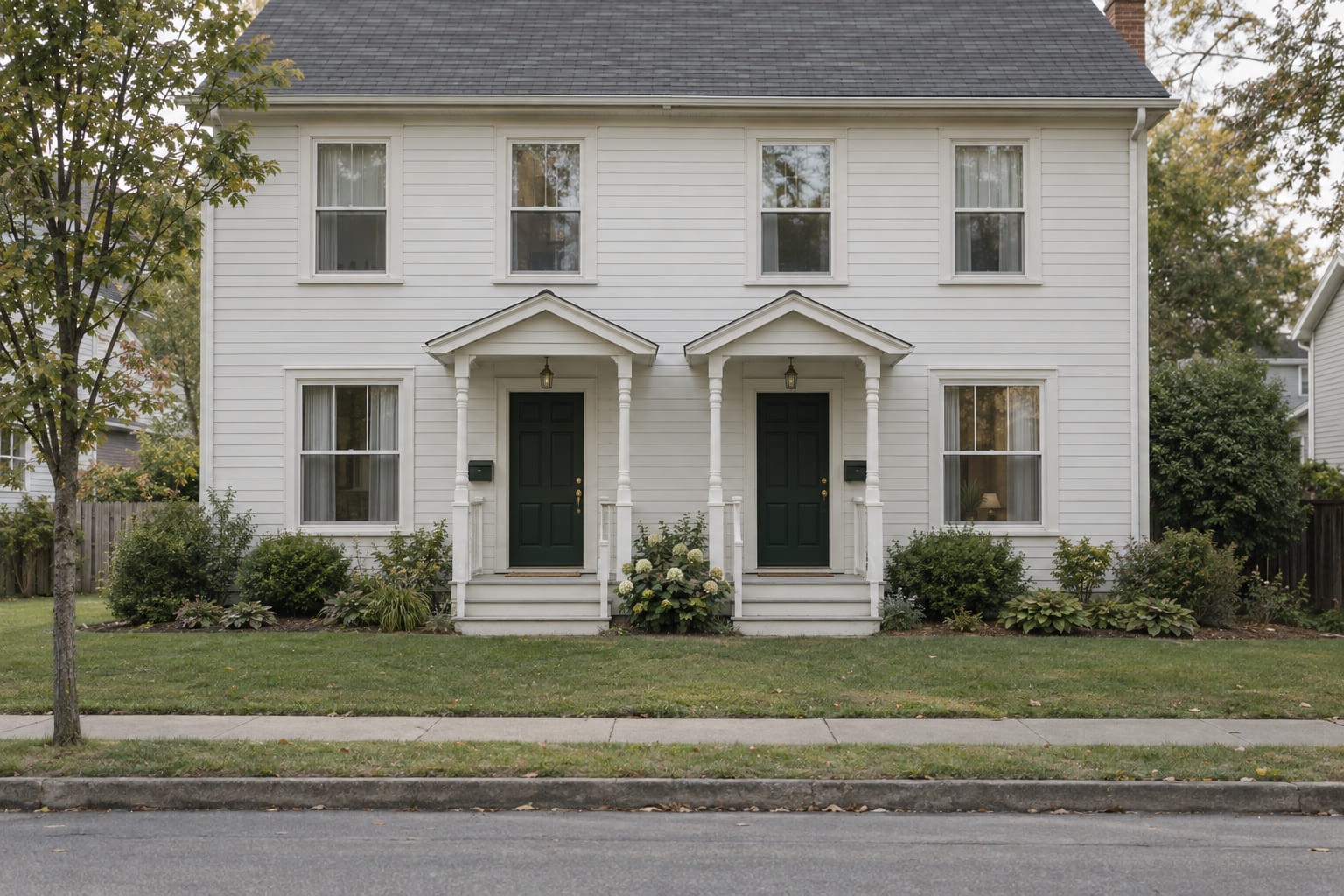
Duplexes, triplexes, and fourplexes can fit residential DSCR programs.
DSCR loans can finance duplexes, triplexes, and fourplexes using the property's rental income to qualify, rather than your salary or tax returns. The lender evaluates the rent it can count from the building and compares it with the proposed monthly housing payment. Lenders also look at your credit, down payment, available reserves, and the property's condition when deciding whether to approve your loan.
When buying a small multifamily property, you need to know how much rental income the lender will count, how much cash you’ll need to close, and whether you can cover the property’s expenses if a unit sits empty. Qualifying for a loan doesn’t necessarily mean the rental will leave you with much money after paying the mortgage and operating costs.
What counts as multifamily for a DSCR loan?
For this guide, small multifamily means a duplex with two units, a triplex with three, or a fourplex with four. These properties can qualify under residential DSCR programs even though more than one household occupies the building.
A building with five or more units generally falls outside the standard 1-4 unit program. A lender may still offer DSCR financing, but the appraisal, income calculation, and loan terms can change. Some commercial programs use net operating income, which subtracts operating expenses from income before comparing it with debt payments. Confirm the formula for the specific program.
If your property has five or more units, use our commercial DSCR loan guide to understand how a lender may evaluate the building's income and expenses.
Can you live in one unit?
Generally, no. Standard DSCR loans require a non-owner-occupied investment property, meaning you cannot plan to live in one unit even if you rent out the others. If you want to buy a duplex, triplex, or fourplex as both your home and a rental, owner-occupied conventional or FHA financing may be a more suitable alternative. Those loans evaluate your personal income and debts, and the lender may also count a portion of the rent from the other units to help you qualify.
How is DSCR calculated on a multifamily property?
For a duplex, triplex, or fourplex, lenders commonly measure whether the combined rent from the units covers the property’s monthly housing payment. Each unit contributes rental income, but the building usually has one mortgage.
Suppose you’re buying a fourplex and the lender accepts $1,100 in monthly rent per unit. That gives you $4,400 in qualifying rent. The property’s monthly payment totals $3,372, including principal, interest, property taxes, insurance, and any association dues, collectively called PITIA.
Divide the accepted rent by that payment:
$4,400 ÷ $3,372 = approximately 1.30 DSCR
A ratio of 1.30 means the qualifying rent is about 30% higher than the housing payment. That extra amount still needs to cover expenses such as repairs, maintenance, and property management, so it is not all profit.
Which rent does the lender count?
The lender may not count all the rental income the seller reports or expects the property to earn. Instead, it reviews each unit’s lease, whether the unit is occupied, and the appraiser’s market-rent estimate to determine how much rent it will use in the DSCR calculation.
- Occupied units: The lender may compare signed lease amounts with the appraiser's market-rent estimates and use the lower figure, depending on the program.
- Vacant units: Some programs accept appraiser-supported market rent if the units meet the lender's condition and vacancy requirements.
- Planned rent increases: Do not assume a lender will count higher future rents while tenants are still paying less under existing leases.
Review the rent the lender counts for each unit so you can see how it arrived at the total. A unit’s current lease, vacant status, or appraiser-estimated market rent may explain why the qualifying income is lower than you expected.
What requirements should you compare?
DSCR loan requirements vary by lender and by the property you’re financing. The down payment, credit score, and rental income needed for approval can also affect one another. For example, a lender may offer a smaller down payment only if you have stronger credit or the property’s rent comfortably covers its monthly housing payment.
To compare down payment requirements, start with the maximum loan-to-value ratio available for your situation.
Loan-to-value (LTV) compares the loan amount with the property value used by the lender. For example, if you buy a property for $500,000 and it appraises for the same amount, a 75% LTV means the maximum amount you can borrow is $375,000. You would cover the remaining $125,000 with your down payment, plus closing costs.
| Requirement | What it means for your purchase |
|---|---|
| Eligible property | Confirm the legal unit count, rental use, location, and condition fit the program. |
| Credit score | The minimum score establishes eligibility; stronger credit may improve available terms. |
| Down payment and LTV | Obtain the limit for your unit count and qualifications, rather than relying on a single-family headline. |
| DSCR | Confirm the qualifying ratio and the rent calculation used to reach it. |
| Reserves | Determine how much eligible money must remain available after the purchase. |
| Appraisal | The report must support the property's value and the rent used for qualification. |
Published lender programs illustrate the differences. Griffin Funding's DSCR program lists a minimum credit score of 620. Visio Lending's DSCR guide lists a 680 minimum and says its minimum 20% down payment can increase based on property type, credit, and market conditions. Even if you meet the lender’s minimum credit score and down payment requirements, approval still depends on the property’s rental income, condition, and your cash reserves.
Many lenders require a DSCR of at least 1.00, and a higher ratio may help you qualify for better pricing. Some lenders allow a DSCR below 1.00 if you have stronger credit, a larger down payment, or more cash reserves. For example, Griffin Funding says it has no set minimum DSCR and will review lower ratios alongside other qualifications. Some lenders might also offer a no-ratio option which does not use rental income to qualify you. Check whether these options are available for the multifamily property you plan to finance.
Can more units improve your DSCR?
Yes, more units can improve your DSCR if their combined rent is high enough relative to the property’s monthly housing payment. A duplex or fourplex may bring in more total rent than a single-family home, even if each unit rents for less. But a higher purchase price, larger mortgage, or higher taxes and insurance can offset that advantage. Compare how well each property’s qualifying rent covers its monthly housing payment, rather than focusing only on the number of units.
Consider four properties with the same illustrative financing:
- Purchase price and appraised value: $500,000.
- Down payment: 25%, or $125,000.
- Loan: $375,000 at an illustrative 7.50% fixed rate over 30 years.
- Monthly principal and interest: about $2,622.
- Monthly property taxes: $500; insurance: $250; association dues: $0.
- Total monthly PITIA: about $3,372.
| Property | Illustrative qualifying rent | DSCR |
|---|---|---|
| Single-family home | $2,900 | 0.86 |
| Duplex | 2 × $1,650 = $3,300 | 0.98 |
| Triplex | 3 × $1,350 = $4,050 | 1.20 |
| Fourplex | 4 × $1,100 = $4,400 | 1.30 |
The fourplex provides the strongest coverage in this example because its combined rent is highest. Real properties may have different rates, taxes, insurance costs, repair needs, and achievable rents. A single-family home could also perform better in a different market.
For your own comparison, add the qualifying rents from all units and enter the total in our DSCR calculator. Use each property's quoted financing and estimated housing costs so the comparison reflects the buildings you are actually considering.
What changes if you put more money down?
On the same fourplex, increasing the down payment from 25% to 30% reduces the loan from $375,000 to $350,000. Keeping the same rate, term, taxes, and insurance, PITIA falls to approximately $3,197 and DSCR rises to 1.38 ($4,400 ÷ $3,197).
The extra $25,000 down lowers the monthly payment by about $175. That can strengthen coverage, but it also leaves less cash available for repairs or vacancies unless you budget separately for them.
Does a qualifying DSCR mean the building will make money?
No. Qualifying for a DSCR loan means the property meets the lender’s requirements, but it does not guarantee a profit. In a rent ÷ PITIA calculation, the lender compares qualifying rent with principal, interest, taxes, insurance, and any association dues. That leaves out costs such as management, maintenance, leasing, and owner-paid utilities.
Vacancies also reduce the rent you collect, so a property can qualify for financing and still leave you covering expenses out of pocket.
Returning to the fourplex example above that is collecting $4,400 a month, suppose you budget an illustrative 18% of scheduled rent, or $792, for vacancy, management, and routine maintenance, plus $250 for owner-paid water and trash.
| Monthly budget item | Amount |
|---|---|
| Scheduled rent | $4,400 |
| PITIA | −$3,372 |
| Vacancy, management, and maintenance allowance | −$792 |
| Owner-paid water and trash | −$250 |
| Estimated amount remaining | −$14 |
The property's qualifying DSCR remains about 1.30, while this operating budget shows a small shortfall. The 18% allowance is an illustration, not a recommended budget for every property. Use local management quotes, repair estimates, utility bills, and realistic vacancy assumptions. Major replacements and unusual repairs need their own funding plan.
What happens when one unit is vacant?
You lose that unit’s rent, but the mortgage and most property expenses continue. The occupied units still bring in income, which can make a vacancy easier to manage than losing the only tenant in a single-family rental. Whether that remaining rent is enough depends on your payment and operating costs. Cash reserves can help cover the gap while you find a new tenant.
In the fourplex example above, each unit rents for $1,100 a month. If one is empty, collected rent drops from $4,400 to $3,300. That leaves you $72 short of the $3,372 monthly PITIA, before maintenance, management, utilities, and other expenses. If the unit stays vacant for three months, you miss $3,300 in rent.
A larger down payment upfront can reduce that pressure. With 30% down, the same financing assumptions produce a monthly PITIA of about $3,197, instead of $3,372. The three occupied units would cover that payment with approximately $103 left over, but that still may not be enough to pay the building’s other bills.
To see how much you might need to pay out of pocket, add up the monthly housing payment and other property expenses, then subtract the rent from the occupied units. If your budget already includes an estimate for lost rent, adjust it so you do not count the same vacancy twice.
How much cash do you need to buy a fourplex?
You’ll need enough money for the down payment and closing expenses, plus any savings the lender requires you to keep after the purchase. Those remaining savings are called cash reserves and can help you cover mortgage payments if rent stops coming in or an unexpected expense arises.
Saving enough for the down payment alone may not be enough to qualify. When planning your budget, separate what you’ll pay to complete the purchase from what must remain available afterward.
Using the same example above, assume the $500,000 fourplex with 25% down, an illustrative $12,000 for closing costs, prepaid expenses, and initial escrow funding, plus a lender requirement of six months of PITIA in reserves:
| Cash category | Illustrative amount |
|---|---|
| Down payment | $125,000 |
| Closing costs, prepaids, and initial escrows | $12,000 |
| Total purchase funds before credits or amounts already paid | $137,000 |
| Six months of PITIA retained as reserves | About $20,232 |
| Total funds to plan for | About $157,232 |
The amount still due at closing would reflect your earnest-money deposit, any expenses already paid, and applicable credits. Reserves generally remain in eligible accounts rather than becoming an additional fee paid to the lender. Confirm which assets count and whether other financed properties create additional reserve requirements.
The $12,000 expense estimate and six-month reserve requirement are illustrative assumptions, not verified lender quotes. Points, local transfer charges, title fees, insurance, and tax escrows can change that amount.
Use our cash-to-close calculator to estimate the purchase funds, then account for required reserves separately unless the tool includes them. This helps you see both what you must pay and what must remain available afterward.
What does the multifamily appraisal need to show?
The appraisal helps the lender evaluate what the building is worth, what its units could rent for, and whether the property meets the loan program’s requirements. For a buyer, those findings can affect how much you can borrow, how much cash you need, and whether repairs are required.
Here are four things to review:
- Property value: A lower appraised value can mean a smaller loan. Suppose you agree to pay $500,000, but the building appraises for $480,000. If the lender’s maximum LTV is 75%, the maximum loan based on that value would fall from $375,000 to $360,000. Unless the purchase price changes, you would need $15,000 more toward the purchase.
- Market rent: The appraiser estimates what the units could rent for based on comparable rentals. Depending on the program, the lender may compare those estimates with existing leases. If it accepts less rent than you expected, your DSCR could be lower even if the building appraises at the purchase price.
- Unit count and permitted use: Do not assume every space the seller rents out will count as a separate unit. A converted basement or garage may need further review. Confirm that the lender accepts the building’s unit count and any zoning or permit issues before relying on that extra rent.
- Property condition: The report identifies visible damage and needed repairs. Problems affecting safety or the building’s structure may require repairs or a specialist’s inspection before financing can proceed. The lender determines which conditions are acceptable for its program.
For traditional appraisals of two-to-four-unit properties, Form 1025, the Small Residential Income Property Appraisal Report, documents the building and rental information. Your lender determines the required report for its specific DSCR program.
Before the appraisal, coordinate access to every unit and have current leases and available permit records ready. Once the report is complete, have the lender explain how its findings affect your loan amount and qualifying rent. Our DSCR appraisal guide walks through your options if the value or rent comes in lower than expected.
What should you review when tenants are already in place?
Start with a rent roll, a list of the units, tenants, monthly rents, deposits, and lease dates. Compare it with the signed leases and available payment records. A fully occupied building can still have unpaid rent, concessions, or expenses omitted from a listing.
Before closing, review:
- Rent actually collected: Check for arrears, discounts, or informal arrangements.
- Lease obligations: Identify end dates, renewal terms, and responsibilities for utilities and maintenance.
- Deposits and tenant records: Confirm how these will be transferred and recorded at closing.
- Near-term costs: Review expected turnovers, known repairs, and shared utility bills.
When buying a property with tenants already in place, you may need them to sign an estoppel certificate, which confirms their rent and other lease terms. Whether you need this document depends on your purchase agreement, local practice, and lender requirements. It is not required for every DSCR loan.
Those lease details can also affect your financing, especially if a tenant pays less rent than you expected. If one unit rents for $900 instead of $1,100, total qualifying rent in our fourplex example falls to $4,200. Dividing that by the $3,372 PITIA gives a DSCR of approximately 1.246, slightly below a 1.25 requirement. A calculator might round the result to 1.25, so confirm how your lender treats the exact figure before assuming the property qualifies.
Use our DSCR loan document checklist to organize the financing records, and add the building's individual leases and rent roll for lender review.
Can you buy a multifamily property through an LLC?
Many DSCR programs permit ownership through a limited liability company (LLC). The lender still reviews the people guaranteeing the loan, the entity's ownership, and who has authority to sign. LLC ownership does not automatically remove personal responsibility for the debt; personal guarantees are common. Griffin Funding, for example, publishes DSCR options for LLC borrowers. Confirm that the proposed entity and property fit the program before finalizing your closing arrangements.
Our LLC entity document checklist can help you assemble formation and ownership records so missing entity paperwork does not delay the purchase.
How should you compare offers and a future refinance?
Request quotes from lenders using the same property information, rent evidence, down payment, and repayment structure. Compare the interest rate, points, lender fees, accepted rent, required reserves, and any prepayment penalty. Confirm whether payments include principal or are interest-only for an initial period.
DSCR loans for rental investments are generally treated as business-purpose loans, so lenders typically are not required to provide the standard Loan Estimate form. Still, request a written breakdown of each offer upfront, including:
- The interest rate
- Points
- Lender fees
- Estimated closing costs
- Monthly payment
- Any prepayment penalty
Confirm whether the rate is locked and which costs could change. Having these details in writing makes it easier to compare the full cost of each loan.
Can higher rents help you refinance later?
Higher documented rents can strengthen coverage, but the refinance must qualify using the new loan's payment and current program rules. A higher interest rate, more cash borrowed, or higher insurance and taxes can offset the benefits. Higher rents also do not guarantee a higher appraised value.
Before relying on a future refinance, confirm ownership-seasoning requirements, which determine how long you must own the property, and how the lender will document its rent and value. Our DSCR cash-out refinance guide explains how the new payment and available equity affect the amount you may receive.
Why does the prepayment penalty matter?
A prepayment penalty is a fee that may apply when you pay off the loan early, including through a sale or refinance. Some loans use a declining schedule, such as 5%-4%-3%-2%-1% over five years; structures and availability vary.
For illustration, a 3% penalty on a $370,000 payoff balance would cost $11,100, in addition to refinance expenses. That can change whether refinancing after a rent increase makes financial sense.
Use our prepayment penalty calculator to estimate the potential payoff cost for your timeline. Match the inputs to your actual loan agreement, including the percentage, penalty period, and calculation method.
Frequently Asked Questions
Yes. Many residential DSCR programs accept duplexes as investment properties. Qualification depends on the property's accepted rent, proposed payment, condition, and your credit, equity, and reserves.
Not always. Some programs allow vacant, rent-ready units to qualify using appraiser-supported market rent. Confirm the permitted number of vacant units and any additional down payment or reserve requirements before relying on projected income.
In a common 2-4 unit DSCR program, the lender adds each unit's accepted rent and calculates one DSCR for the property. Reviewing each unit separately helps establish the income included in that total.
You may need 20%–30% down for a multifamily DSCR loan, depending on the lender, your credit, the property’s DSCR, and the number of units. Confirm the requirement for your specific property before setting your budget, and account for closing costs and required cash reserves separately.
Not always. Your rate depends on the lender, property type, your credit, down payment, and DSCR. Get a quote for the property you plan to buy instead of assuming it will have a higher rate than a single-family rental. Compare fees and any prepayment penalties, too.
Not necessarily. A 1.25 DSCR means qualifying rent is 25% higher than the monthly housing payment, including the mortgage, taxes, insurance, and any association dues. For example, $4,000 in rent and a $3,200 housing payment leave $800 for management, maintenance, repairs, utilities, and other expenses. If those costs exceed $800, you would need to cover the difference yourself. Vacancies can also reduce the rent you collect, so a 1.25 DSCR alone does not guarantee a profit.
Yes, some lenders offer DSCR financing for buildings with five or more units through multifamily or commercial loan programs. These programs have different rules from loans for one-to-four-unit rentals. Confirm how the lender calculates rental income, what appraisal it requires, and how long you have to repay the loan. Also check for a balloon payment, which means a large remaining balance comes due at the end of the loan term.
DSCRLoans101 is an independent editorial site. We do not originate loans and we are not affiliated with any lender. Every figure on this page comes from published lender materials or primary sources, and we publish the date we verified it.
More in Property Types See every guide in this section